Signs of Foundation Movement Caused by Weak Soil
Last updated: September 10, 2026
Key Takeaways
- Soil should slope away from the house for at least the first 6 feet.
- Inspect all four sides within 10 to 15 minutes, and note where cracks, gaps, or settlement are concentrated.
- Document and recheck after 2 to 4 weeks.
- Those are useful because foundation distress is often slow enough to track over 2 to 8 weeks, not minutes.
Cracks in the walls. A sticking door. A slab that no longer feels level. Those are the early signs of foundation movement caused by weak soil, and I’d look there before I blamed almost anything else. The real question is not simply “Is the foundation moving?” It is “Is the ground under it failing to carry the load?” That distinction matters. Weak soil leaves a trail, and that trail can point to normal settling, shrink-swell clay, loose fill, or something nastier.
Who this applies to — and who should do something else
This is for homeowners and property managers who can already see symptoms such as cracks, sloping floors, or gaps around trim and want to judge whether weak soil is the likely cause. I’m assuming you can inspect a crawlspace, basement, or slab edge, and that you know the difference between a cosmetic crack and a structural one. Also, the building is already in service; this is about diagnosing movement, not designing a new foundation.
Weak soil usually means soil that loses strength under load, compresses too much, or changes volume with moisture. In practice, that can include expansive clay, loose fill, organic topsoil left under a slab, poorly compacted backfill, and saturated silty soils. A building on competent soil can still crack, but the pattern often looks different. That’s the tell: soil-related movement has a shape.
This is not a do-it-yourself repair guide. You can handle the inspection, the measurements, and the recordkeeping. But you should not choose underpinning, helical piers, slabjacking, or excavation without a structural engineer or qualified foundation contractor. Get that wrong, and the fix can trap the movement, bury the drainage issue, or shove the load into the same weak layer. If a wall bows inward, a support post sinks, or the house shifts suddenly after heavy rain, I’d stop the self-check and call in qualified help.
One exception exists. Monitoring. A 1/8-inch crack gauge, a ruler, a level, and dated photos are enough for an initial read. Handy, honestly. Foundation distress often moves slowly enough to track over 2 to 8 weeks, not minutes.
What signs point to weak soil instead of normal settling?
Uneven movement, repeat cracking, and seasonal change usually point to weak soil; one harmless hairline crack does not. Normal shrinkage cracks in drywall or a single diagonal crack in fresh concrete can show up without structural trouble. Weak soil tends to leave a broader, messier pattern.
Start with doors and windows that bind at one corner but not the whole frame. Once a frame racks out of square, the opening is being distorted by differential movement — one part of the foundation is settling more than another. A trim gap wider than about 1/8 inch, or a door latch that suddenly takes force after working fine for months, deserves more attention than a small paint crack.
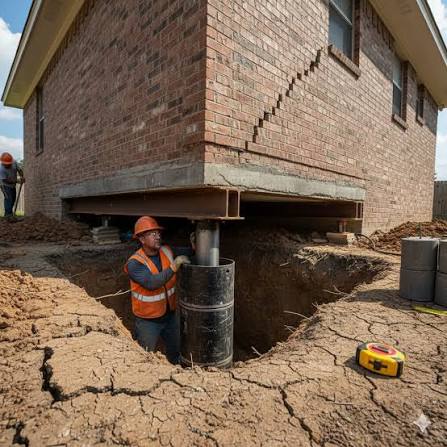
Now look at the cracks themselves. Stair-step cracks in brick or block walls often point to movement along mortar joints. Horizontal cracking in a basement wall is a different warning and can mean lateral soil pressure, not just settlement. A crack that widens toward the top on one side or toward the bottom on the other often means one part of the foundation is dropping or rotating. One vertical crack in poured concrete can be less serious than several that keep opening after rain. Strange, but true.
Floor slope is another clue. If a 6-foot level shows a noticeable pitch across a room, or marbles keep rolling toward one corner, the structure is not sitting evenly. I would not treat a floor dip of 1/4 inch over a short span as proof of failure; a structural engineer or qualified foundation contractor should confirm whether it matters. That is enough to log and compare over time.
Outside, check for soil pulling away from the foundation, puddling near one side of the house, and downspouts dumping water within 3 to 5 feet of the wall. Weak soil often fails because water changes its bearing capacity. Clay swells when wet and shrinks when dry; loose fill loses support when saturated; organic soils compress as they decay. Mud pie science, basically.
How do I tell if the soil is the problem?
Match the damage pattern to the ground conditions, the moisture pattern, and the movement pattern over time. One clue is not enough. Three or four together usually are.
Start with the site. If the house sits on a lot that was graded up with fill, built on a slope, or landscaped after construction with added soil, I’d suspect compaction issues or mixed fill first. Fill placed in lifts should be compacted; the common field standard is the Proctor compaction test, described in ASTM D698 for standard compaction and ASTM D1557 for modified compaction. You do not need to run those tests yourself, but those names tell you what a soil lab is measuring when it says the soil is dense enough for support.
Then check moisture. Weak soil problems often change with seasons. If cracks open wider during dry months and close slightly after long wet periods, expansive clay is a likely suspect. If movement gets worse after heavy rain or broken irrigation, the soil may be losing strength because of saturation or poor drainage. If the problem is worse near one corner, look for a downspout, a leaking hose bib, or a sump discharge dumping water there. One soggy patch can undermine a footing while the rest stays put.
Materials matter too. Masonry walls tend to show stair-stepping or separation at mortar joints. Poured concrete walls more often show vertical or diagonal cracks. Slab-on-grade homes often reveal the problem through slab cracks, tiled floor grout breaks, and interior doors that drift out of alignment. Crawlspace homes may show isolated pier settlement, sagging beams, or posts punching into soft soil.
Timing helps as well. If cracks appeared gradually over months and changed after a wet winter, soil is more plausible than a one-time impact. If the structure was recently remodeled and a heavy load was added — a stone veneer, a new second floor, a water feature, or large planters near the foundation — the added load may have exposed marginal soil capacity. That does not prove the addition caused the issue, but it trims the list fast.
What should I check before I assume the foundation is failing?
Drainage, site grading, and interior movement come before calling every crack a foundation emergency. Plenty of buildings show symptoms that look structural but come from water management or finish materials.
First, measure slope and crack width. Use a 6-foot level on floors and a ruler or crack gauge on visible cracks. Write down the date and location. A crack that stays at 1/16 inch for 3 months is different from one that grows to 3/16 inch after one storm cycle. You’re looking for change, not just presence.
Second, inspect the perimeter. Soil should slope away from the house for at least the first 6 feet. If water pools near the foundation after a rain, the soil there may be softening and losing support. Downspouts should carry roof runoff away from the foundation. Short splash blocks are often not enough on sites with heavy runoff.
Third, check for plumbing leaks. A slow leak under a slab can mimic weak soil by saturating and softening the subgrade. Hot spots on a floor, unexplained water use, or damp crawlspace soil matter here. If movement is localized near a bathroom, kitchen, or utility area, a leak becomes more likely.
Fourth, look at trees and roots. Large trees within 10 to 20 feet of a foundation can dry clay soils unevenly and cause seasonal shrinkage. That is not always the only problem, but it is often part of it. The result is often one side of the house moving more than the others.
Finally, compare inside and outside. If the same corner shows exterior brick cracking, interior drywall separation, and a floor dip, the evidence points in one direction. If only paint and trim are damaged, I’d be more cautious about calling it structural.
The step-by-step check I would use
I’d use a simple 7-step inspection because it keeps you from guessing too early.
- Walk the perimeter and mark the worst side first. Inspect all four sides within 10 to 15 minutes, and note where cracks, gaps, or settlement are concentrated. Verify: one side should not carry all the damage if the cause is general soil compression. Problem sign: a single corner with repeated cracking, sinking soil, or a downspout nearby.
- Measure crack widths at 3 points each. Use a ruler or crack gauge and record widths at the top, middle, and bottom of each visible crack. Verify: width changes over the crack length can indicate rotation or differential movement. Problem sign: widening at one end, especially above 1/8 inch, or a crack that is visibly growing between checks.
- Check floor level in 6-foot spans. Place a level across hallways, rooms, and near doors, then note the direction and amount of slope. Verify: the slope should be consistent with the building’s age and framing, not abrupt. Problem sign: a new dip, hump, or change greater than what was previously present in the same area.
- Inspect drainage at the roof edge and grade. Confirm that gutters are functional and that discharge carries water at least several feet away. Verify: no ponding should remain near the foundation after rainfall. Problem sign: downspouts ending right at the wall, eroded soil, or mulch washed against the footing.
- Look for soil moisture clues. Check for damp crawlspace soil, clay that shrinks away from the wall, or soft spots underfoot. Verify: the soil condition should be relatively consistent around the structure. Problem sign: one wet zone, one soft patch, or a repeated wet-dry pattern near a damage corner.
- Compare doors, windows, and wall finishes. Open and close each door and window, then inspect for diagonal drywall cracks or separated trim. Verify: a single sticking door is less useful than a cluster of small distortions in the same area. Problem sign: multiple openings out of square on the same side of the house.
- Document and recheck after 2 to 4 weeks. Take dated photos from the same distance and angle, especially after rain or a dry spell. Verify: stable conditions should produce little change. Problem sign: any measurable increase in crack width, new gaps, or new floor slope.
If the evidence points to weak soil, the next useful question is not “Which cosmetic fix hides the crack?” It is “What is driving the soil to lose support?” A structural engineer or qualified foundation contractor can help confirm whether weak soil is the cause.
When should I stop treating this like a homeowner check?
Stop the DIY inspection and bring in a qualified structural professional or foundation contractor in these cases.
A horizontal crack appears in a basement or retaining wall: This often means lateral soil pressure, not routine settling — the wall may be failing under load. What to do: stop adding water to the area, avoid backfilling changes, and get a structural evaluation promptly.
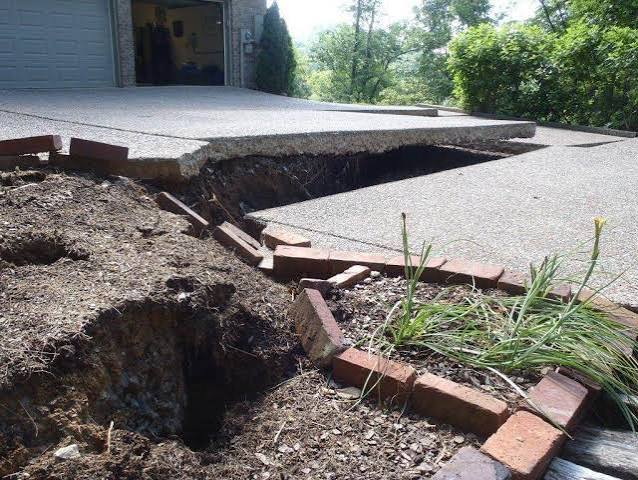
A corner or pier seems to be dropping quickly: Rapid differential settlement can worsen framing damage and crack finishes further — delays can turn a repair into a larger underpinning job. What to do: document the movement and seek qualified help before trying any patch.
Doors, cabinets, or floors shift noticeably over days or weeks: Active movement suggests the cause is still in play — the structure may continue to distort. What to do: monitor no more than briefly, then move to professional diagnosis.
There is standing water, a plumbing leak, or repeated dampness near the foundation: Wet soil cannot be evaluated honestly until the moisture source is controlled — any repair may fail if the ground stays soft. What to do: fix the water source first, then reassess after the soil dries.
The building sits on a slope, deep fill, or older undocumented fill: The soil conditions may be outside simple visual judgment — bearing capacity can vary sharply over short distances. What to do: get a site-specific assessment before choosing a repair method.
Cracks are wider than about 1/4 inch or widening visibly: That level of movement often means more than finish damage and may affect structure. What to do: stop guessing and get the foundation examined.
The mistakes people make, and what they cost
The first mistake is patching cracks before checking movement. A cosmetic seal hides the symptom, not the cause, and can erase the clue you needed to diagnose the problem. Better to measure first. Patch later.
The second mistake is fixing drainage on only one side. If the entire lot sheds water toward the house, a single downspout extension will not solve the problem. The consequence is that the same corner keeps moving. I’d correct grade, gutters, and discharge together where possible.
The third mistake is assuming all settlement is permanent and harmless. Some movement is old and stable; some is active. If you do not compare measurements over time, you cannot tell the difference. A dated photo set and a crack log are cheap insurance.
The fourth mistake is overreacting to one interior crack. Drywall joints, plaster keys, and finish materials crack for reasons that have nothing to do with the footing. The consequence is wasted money on the wrong fix. The better move is to match interior symptoms with exterior and structural clues.
The fifth mistake is ignoring soil type. Expansive clay behaves very differently from loose sandy fill or organic soil. A one-size-fits-all repair choice is how people end up with repeated movement after a heavy rain or dry spell. If you know the soil classification from a geotechnical report or even a county map, use it.
What happens if the soil is expansive or the site has fill?
Standard advice changes when the ground itself is the issue. On expansive clay, the goal is often moisture control first, because the soil swells when wet and shrinks when dry. On fill, the job is often to confirm whether the material was compacted in lifts and whether settlement has stabilized. In both cases, the signs of foundation movement caused by weak soil can be misleading if you look only at the crack and not the ground.
A geotechnical report is the cleanest way to sort this out. According to the U.S. Geological Survey, expansive soils can damage homes and other structures by moving as moisture changes; the National Association of Home Builders notes that poor drainage and expansive soils are major contributors to foundation problems; and ASTM standards such as D698 and D1557 are used to evaluate compaction for support. If you are deciding between repair options, this is where a site-specific diagnosis matters more than a guess.
If the lot has trees, irrigation, or recent grading, those factors can keep the soil cycling and make the movement worse. In that case, the practical answer is not to seal the crack first but to understand what the weak soil is doing and whether the moisture pattern can be controlled.
What a repair usually has to address
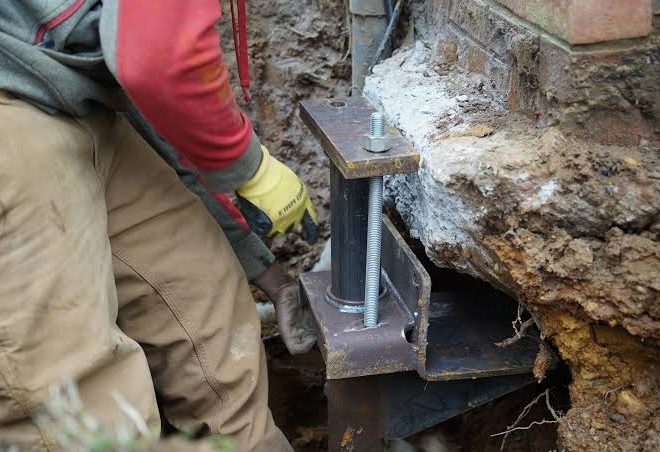
A durable repair usually addresses one or more of three things: load transfer, soil moisture, or soil support. Piers and underpinning try to move weight to deeper, stronger strata. Slabjacking or foam lifting can restore elevation in some slab situations. Drainage correction and grading changes try to stop the soil from changing strength in the first place.
The right choice depends on how far the signs of foundation movement caused by weak soil have progressed. Small, stable cracks may need monitoring and drainage work. Active settlement, repeated widening, or structural distortion usually needs engineering input. If the soil is the real cause, a repair that ignores it can look good for a while and fail again.
When you compare options, ask what problem each one solves, how it affects moisture, and whether it depends on the same weak soil staying stable. That keeps the decision tied to the cause instead of the symptom.
A simple comparison of common responses
| Response | Typical use | Typical cost range | What it addresses | Limitation |
|---|---|---|---|---|
| Drainage correction | Water pooling, wet soil, seasonal movement | $500 to $5,000+ | Moisture that weakens soil | Does not lift settled structure |
| Crack monitoring | Small, stable cracks | $0 to $50 | Confirms whether movement is active | No structural repair |
| Slabjacking / foam lifting | Sunken slab areas | $1,500 to $7,500+ | Elevation loss in slab sections | Does not fix bad drainage or deep settlement |
| Helical piers / underpinning | Active settlement, weak bearing soil | $3,000 to $25,000+ per section or pier line | Transfers load to stronger strata | Requires design and installation expertise |
| Structural engineer evaluation | Unclear cause, significant movement | $500 to $2,500+ | Diagnosis and repair recommendation | Not a repair by itself |
Short answer
Signs of foundation movement caused by weak soil usually show up as uneven cracks, sloping floors, sticking openings, and moisture-related change. The key is to separate active movement from old, stable damage and to connect the symptoms to drainage, fill, clay, or other weak soil conditions. Measure, compare, and document before you repair. If the movement is active or the soil conditions are unclear, get a structural professional involved.