Soil Stabilization Methods and Decision Framework: The Complete Guide
Last updated: October 24, 2026
If the subgrade is weak, wet, or too plastic to hold load, soil stabilization can be the fastest path to a buildable platform — but the right method depends on why the soil is failing. In this guide, Soil stabilization methods and decision framework — The Complete Guide means choosing between drying, strengthening, separating, draining, or replacing the problem layer based on the soil report and the project target.
Soil stabilization is not one technique. It is a set of fixes for different failure modes: high moisture, low bearing capacity, pumping fines, frost susceptibility, shrink-swell clays, erosion, and settlement. A wrong choice wastes money and can make the ground harder to fix later. A right choice can turn a site that barely supports access equipment into a pavement, pad, embankment, or working platform that behaves predictably. In practice, the choice often comes down to one of five methods: lime, cement, mechanical compaction, geosynthetics, or full-depth replacement.
I write on geotechnical and construction materials topics, so I am comfortable translating lab terms like Atterberg limits, CBR, UCS, and seepage control into decisions a project team can actually use. For method selection, the practical checks often come from ASTM compaction and strength tests and from AASHTO field and design guidance. ASTM D698 and ASTM D1557 are common Proctor compaction references, and ASTM D4318 covers Atterberg limits. AASHTO design and soil-support practices are also widely used in project specifications. (Source: AASHTO)
Key takeaways
- The best stabilization method depends on the soil’s failure mechanism, not on habit or crew preference.
- Lime is usually the first serious candidate for wet, plastic clays; cement is often better for granular soils and mixed soils that need immediate strength.
- Mechanical compaction helps only when the soil has the right moisture window and enough gradation to densify.
- Geosynthetics solve separation, reinforcement, and drainage problems, but they do not “fix” weak soil chemistry.
- Full-depth replacement is blunt but reliable when the problem zone is shallow and access is easy.
- Deep soil mixing and other in-place binders make sense when excavation is impractical or the weak layer extends beyond practical removal depth.
- The decision is often limited by drainage, groundwater, frost, sulfate content, carbon footprint, schedule, and what the finished layer must support.
- A simple field rule is that the right choice should match both the soil type and the depth of the problem, not just the lowest first cost.
What soil stabilization actually has to solve
Soil stabilization works when it changes the soil’s behavior enough to meet the project’s performance target — bearing, rut resistance, settlement control, or erosion resistance. That target should be stated before any method is chosen. A haul road, for example, cares about repeated wheel loads and pumping. A building pad cares about differential settlement. A ditch slope cares about surface erosion and moisture movement. A runway subgrade cares about uniform support and frost behavior.
The generic mistake is to ask, “What’s the strongest method?” Strength is only one variable. A lime-treated clay may gain stiffness, but if the site has sulfate risk, that same choice can create heave or durability problems, so a geotechnical professional should review the chemistry before treatment is specified. FHWA Geotechnical publications discuss soil treatment and site-specific evaluation. A cement-treated layer may reach high early strength, but if the soil is too wet and poorly mixed, the finished mass can crack or remain inconsistent, so a mix design and field QC plan should be checked before construction starts. FHWA A geotextile may stabilize traffic during construction, but it will not cure a highly compressible organic deposit, so a specialist should confirm that separation or reinforcement is the right use. FHWA Geosynthetics
The right starting point is a site characterization that at least identifies grain size, moisture content, plasticity, organic content, groundwater level, and the intended loading condition. ASTM and AASHTO testing frameworks are useful here: Atterberg limits for plasticity, Proctor compaction for moisture-density behavior, and strength tests such as UCS or CBR where the design calls for them. On a serious project, the question is not “Can I stabilize this soil?” It is “Can I stabilize it to the performance the structure needs, within the excavation, cost, and schedule I actually have?” A standard lab program can answer that question before the work starts. (Source: ASTM D698 ASTM D1557 ASTM D4318)
That is why the decision framework matters more than a shopping list of methods.
Which stabilization method fits which soil?
The best all-around choice is usually the one that matches the soil’s chemistry and the project’s loading pattern, but that should be confirmed with testing rather than assumed. That sounds obvious, but it is where most field mistakes happen: crews select a familiar method instead of the method that solves the dominant problem.
For clayey soils with high plasticity and moisture sensitivity, lime is often the first method to consider. It reduces plasticity and improves workability, which matters when the soil is sticky, wet, and hard to compact. For granular soils, low-plasticity silty sands, or blended soils needing strength gain, cement or other hydraulic binders often perform better because the mechanism is cementation rather than plasticity reduction. For loose granular soils, mechanical densification can be enough if the moisture and gradation are right. For very weak or compressible deposits, geosynthetics, columns, or full replacement may be more honest than pretending a light surface treatment will solve the problem.
The key distinction is this: some methods change the soil, and some methods manage the soil. Lime and cement change the material. Geotextiles, geogrids, and drainage layers mostly manage how the soil behaves under load. Compaction improves the soil if the water content is in range. Replacement removes the problem soil altogether. In many projects, that means the “best” method is really the best fit for a specific layer and a specific load.
A second distinction is depth. If the weak zone is the top 300 mm to 600 mm, surface stabilization is often enough. If the problem extends several meters down, the method has to reach deeper or the project will keep failing beneath the treated crust. That is why a thin treated layer over a soft deposit can look good on day one and rut badly after the first storm. A shallow fix can work, but only when the weak zone is shallow.
The rule of thumb is simple: use the least intrusive method that actually addresses the failure mode, and do not expect one method to solve every problem at once.
Lime stabilization: where it wins and where it fails
Lime wins on wet, plastic clay because it changes the soil’s workability before it changes its strength. That makes it the practical choice when the material is too sticky to compact, too soft to support construction traffic, and too plastic to behave under repeated moisture changes. Lime treatment is especially useful when the goal is to dry and mellow the soil so equipment can move and compaction can happen. The classic use case is a clay subgrade that is holding too much moisture after rain or groundwater rise.
The main benefit is not just strength gain. Lime can reduce plasticity index, improve short-term handling, and create a more stable working surface. It is often a good fit for subgrades under pavements, access roads, embankment fills, and working platforms where immediate constructability matters. The improvement is often most valuable in the first phase: turning unworkable clay into something the crew can place and compact. In many projects, that can shorten the schedule by days or weeks.
The weakness is equally real. Lime is not the right answer for all soils. It is less effective in sands and low-clay granular soils because the chemistry it relies on is missing. It can also be risky in sulfate-bearing soils, where reactions can lead to expansion and heave. That is not a theoretical footnote; it is a reason to test soil chemistry before spreading lime across a site. Lime also needs mixing control, moisture control, and curing time. If the blend is uneven, the layer can have soft pockets and a misleading surface crust.
A reader should skip lime when the soil is mostly granular, when sulfate issues are suspected, when the project cannot tolerate curing time, or when the stabilized layer must achieve high early structural strength. In those cases, cement, reinforcement, or replacement may be better. Lime is a good tool, but it is not the universal stabilizer many field crews still treat it as.
Cement and other hydraulic binders: when stiffness matters most
Cement-based stabilization wins when the project needs immediate stiffness, higher early strength, and a more structural treated layer. It is often the better choice for granular soils, silty sands, mixed soils, and some clayey soils where the plasticity problem is not so high that lime would be the better first step. If the goal is to create a load-bearing base or improved subgrade that can open quickly to traffic, cement is hard to ignore.
The strength gain is the main attraction. Cement-treated soil can provide a much firmer platform than untreated soil, and it tends to be more directly structural than a moisture-conditioning treatment. That makes it useful for haul roads, yard slabs, pavement bases, and other locations where wheel loads arrive fast and construction windows are tight. If the design is trying to reduce deflection and rutting more than it is trying to alter plasticity, cement often belongs near the top of the list. A mix that reaches target strength quickly can also reduce rework later.
The downside is brittleness. Cement-treated layers can crack if the mix is poorly proportioned, the soil is too wet, or curing is uncontrolled. Those cracks are not always catastrophic, but they can matter if the layer is expected to flex with underlying movement. Cement also does less than lime for reducing plasticity, so a highly plastic clay may still be troublesome even after treatment. In sulfate-prone environments, binder chemistry needs real attention. Some projects use blended binders or additives, but those choices should come from design, not guesswork.
This method is not for a project that needs only temporary trafficability or a low-carbon surface fix. Cement often costs more in materials and can carry a higher embodied carbon burden than mechanical or geosynthetic solutions. It is the right answer when stiffness and early strength are more important than flexibility or chemical moderation.
Mechanical compaction and densification: the cheapest fix that works only sometimes
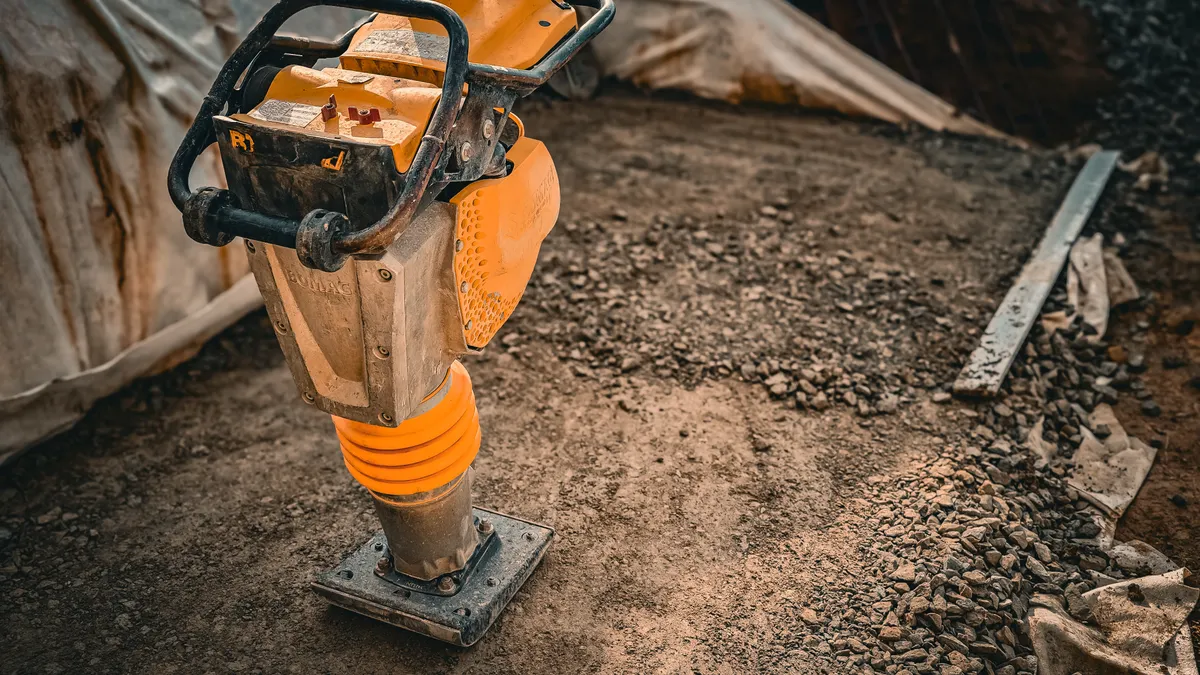
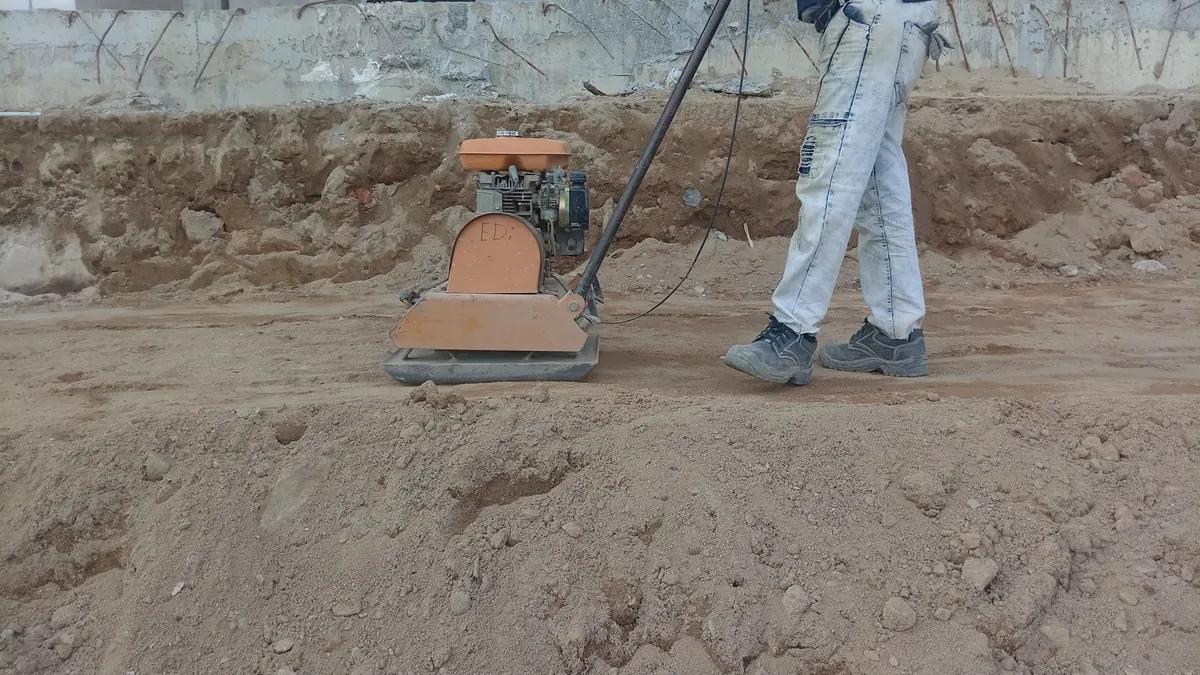
Mechanical compaction wins when the soil is already suitable and the only real problem is that it is too loose, too wet, or placed in the wrong lift thickness. It is the most economical stabilization method when the soil can be brought into the proper moisture window and compacted to the specified density. For fill soils, granular subgrades, and embankments built from controlled material, this is often the first and best line of defense. A well-run compaction program can make a large difference at relatively low cost.
The advantage is obvious: no binder, no chemical reaction, and no need to alter the soil permanently. Compaction is especially effective for granular soils because they rearrange under effort and achieve higher density more readily than clays. Vibro-compaction and related densification methods can also help in certain loose sands, though those are specialized tools and not a substitute for ordinary earthwork control. In many projects, a properly specified Proctor target and field density checks do more good than any additive. A field density check is often worth more than a guess.
The weakness is that compaction cannot fix the wrong soil. Organic soils, highly plastic clays, and saturated fine-grained deposits do not suddenly become good just because a roller passed over them. If the soil is outside its moisture range, compaction may create a dense crust over a weak layer below. That is a classic failure mode: the surface looks acceptable, but the support collapses under load or after rain. Soil that is too wet may need drying, amendment, or removal before compaction can work.
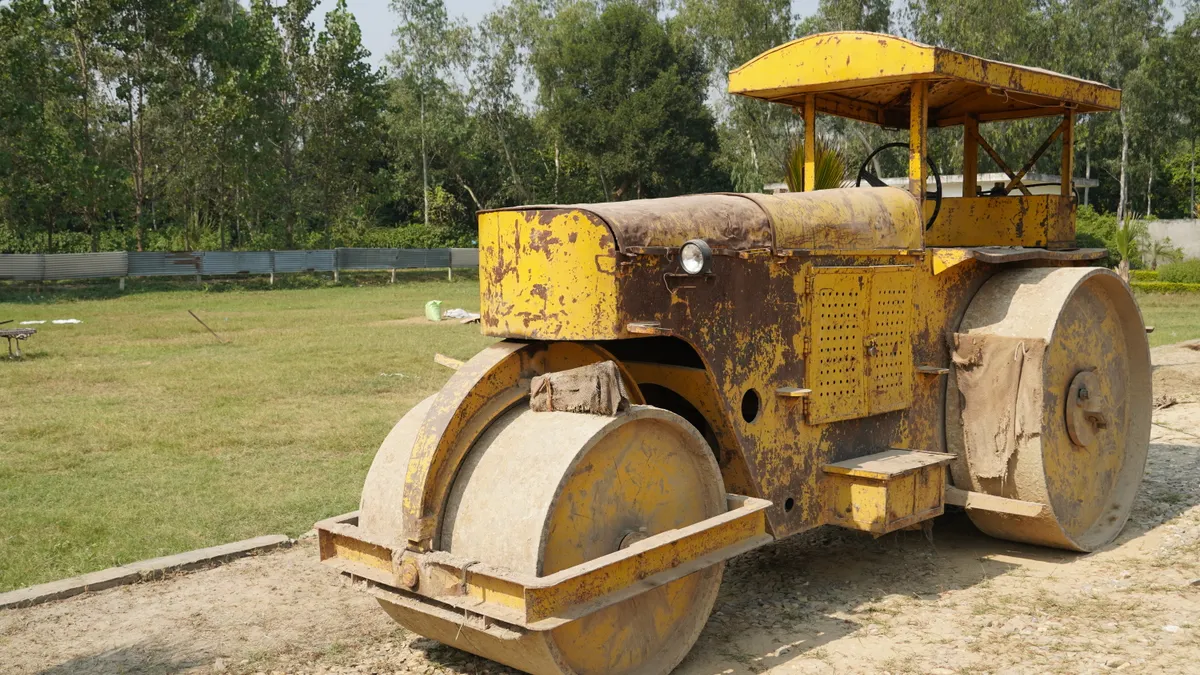
This method is not for sites with deep soft deposits, high groundwater, or soils that cannot be brought into the right moisture range. It also fails when crews treat compaction as a substitute for engineering judgment. A roller is a tool, not a diagnosis.
Geotextiles, geogrids, and drainage layers: stabilization by control, not chemistry
Geosynthetics win when the project needs separation, reinforcement, filtration, or drainage more than chemical strength gain. A geotextile placed between weak subgrade and aggregate base can stop fines from pumping upward and keep the base from disappearing into the soil below. A geogrid can improve load distribution in a granular layer and help the system bridge weak spots. A drainage layer or wick system can manage water movement so the soil does not stay soft. These are system controls, not soil cures.
This family of solutions is often the best choice for temporary roads, unpaved work pads, and layered systems where full soil replacement would be too expensive or too disruptive. The practical value is construction control. A properly selected geotextile can preserve the aggregate layer and reduce contamination. A geogrid can reduce deformation in the base course when traffic is repetitive. Drainage elements can keep moisture from accumulating in the treated zone. On short-duration projects, that can be enough to keep equipment moving.
The limitation is important: geosynthetics do not fix the soil itself. They manage the system. If the underlying soil is highly compressible, organic, or chemically unstable, the geosynthetic may slow the failure but not eliminate it. Selection also matters. A filter fabric that is wrong for the soil gradation can clog. A grid that is poorly anchored or installed on an uneven surface may not mobilize the intended reinforcement. For that reason, the product spec should match the soil gradation and the expected loading.
This is the right family of methods when the soil needs help functioning under load, but the project cannot justify deep excavation or chemical treatment. It is the wrong choice if someone is hoping a roll of fabric will turn a bad subgrade into a permanent foundation layer.
Full-depth replacement, deep mixing, and other heavy-duty fixes
Full-depth replacement wins when the bad soil is shallow, excavation is practical, and long-term reliability matters more than minimizing earthwork. If the weak zone is near the surface and access is straightforward, removing the problem soil and replacing it with engineered fill is often the cleanest decision. It is not glamorous, but it is easy to understand, inspect, and verify. It also gives the contractor a clear stopping point.
The biggest strength is certainty. You are not trying to persuade bad soil to behave; you are removing it. That makes replacement attractive where organics, debris, uncontrolled fill, or unpredictable soft pockets are involved. It is also the method with the clearest quality control path because the replacement fill can be compacted and tested under known conditions. When the weak zone is only a few hundred millimeters deep, this can be the fastest reliable answer.
The drawbacks are cost, haul-off, and disruption. Excavation creates spoils that must go somewhere, and deeper cuts can trigger groundwater, slope stability, or shoring issues. If the bad layer is thick, replacement can become impractical fast. That is where deep mixing, soil-cement columns, lime columns, and similar in-place improvement methods enter the picture. These methods are appropriate when the weak layer is too deep to remove economically or safely, but the project still needs a stronger composite ground mass.
Deep treatment is not a casual choice. It requires specialized equipment, careful QA/QC, and a design that accounts for variability in binder distribution and strength gain. It is a fit for roads, embankments, industrial pads, and infrastructure where in-place improvement is justified by depth or access limits. It is not the first choice for a small pad where simple replacement would be faster and easier to verify.
The honest side-by-side comparison
The best method is the one that solves the failure mode with the least complexity. For most readers, the real choice is not between ten equal options; it is between a chemical treatment, a structural treatment, and a removal strategy. A short comparison table can make that tradeoff clearer.
| Criteria | Lime treatment | Cement or hydraulic binder | Winner for this condition |
|---|---|---|---|
| High-plasticity clay | Strong fit because it reduces plasticity and improves workability | Can strengthen, but does less to calm plastic behavior | Lime |
| Granular soil or low-plasticity silt | Often limited benefit | Better strength mechanism and more predictable stiffness | Cement |
| Need for immediate trafficability | Usually needs more conditioning and curing | Usually better for fast opening to load | Cement |
| Sulfate-risk environment | Can be problematic without testing | Also needs caution, but chemistry can be designed around the issue | Cement, with testing |
| Need to reduce plasticity index | Directly addresses the problem | Less direct | Lime |
| Need for high early stiffness | Moderate, depending on soil and curing | Usually stronger early gain | Cement |
| Moisture control during construction | Can help dry wet clay | Less effective as a drying tool | Lime |
| Lower carbon / lower chemical intensity approach | Still chemical-based | Often more binder-intensive | Neither; consider compaction or geosynthetics |
That table hides an important truth: the “winner” can change with the soil report. A clay with high plasticity and high water content points toward lime. A silty sand under time pressure points toward cement. A site that only needs separation and rut control may not need chemical stabilization at all. The best decision is often a method plus a drainage or separation layer, not a single magic treatment. In many highway and industrial projects, the correct answer is a layered system rather than one additive.
How to choose in practice without overengineering it
The decision framework should start with four questions. First: what is the soil type and what is the dominant failure mode? Second: how deep is the problem layer? Third: what does the finished surface need to carry, and how soon? Fourth: are there chemical, environmental, or construction constraints that eliminate certain options?
If the soil is a wet, plastic clay and the project needs a working surface, lime is usually the first candidate. If the soil is granular or mixed and the priority is stiffness or early strength, cement is usually the first candidate. If the soil is structurally acceptable but weak under the planned traffic, geotextile or geogrid reinforcement may be enough. If the bad layer is thin and shallow, replacement may be the cleanest answer. If the weak zone is deep or the project footprint is large, in-place mixing or deep improvement may be the only practical route.
Do not choose a method before checking the disqualifiers. High sulfate risk can rule out some binders. Organic content can make chemical stabilization unreliable. Groundwater can complicate excavation and curing. Tight schedules can rule out methods that need longer curing. Carbon or permit constraints can shift the project away from binder-heavy solutions. That is not indecision; it is design discipline. It is also where a geotechnical engineer adds the most value.
The most common error is using stabilization as a rescue operation after earthwork has already gone wrong. The better approach is to specify the method early, with lab support and field verification, so the treatment matches the structure instead of trying to patch a failed subgrade after the fact. Early testing often costs far less than a late repair.
Exception scenarios where the verdict flips
The overall recommendation flips in a few real cases, and those exceptions matter more than a polished rule of thumb.
-
The soil is highly plastic, but sulfate risk is confirmed or strongly suspected. In that case, lime may stop being the first choice even though the clay looks perfect for it on paper. A different binder strategy, removal, or a treatment plan built around testing becomes safer.
-
The project needs an open-to-traffic surface in days, not weeks. Here, cement-based treatment can beat lime because early strength matters more than moisture reduction. A schedule-driven project often cannot wait for a slower conditioning process.
-
The weak layer is thin and clearly isolated. Full-depth replacement can become the simplest and most reliable solution. There is no reward for complex stabilization when 300 mm to 600 mm of unsuitable soil can be removed and replaced cleanly.
-
The soil is weak mainly because of water and pumping, not because of material strength. In that case, drainage, separation, and confinement may outperform any chemical treatment. A geotextile or drainage layer can solve the actual problem better than binders can.
These exceptions are not edge cases for the sake of being clever. They are the situations that change a project from “treat it in place” to “remove it,” or from “dry it” to “drain it.” A project team should review them before approving the final method.
The verdict: which method to choose and why
Choose lime stabilization if the soil is a wet, plastic clay and the project needs better workability, lower plasticity, and a buildable subgrade. Choose cement or another hydraulic binder if the soil is granular or mixed and the goal is faster stiffness, higher early strength, or a more structural treated layer. Neither if the site has organic soil, deep compressible deposits, or unresolved sulfate or groundwater problems that make superficial treatment a bad bet. In those situations, replacement, drainage, or a deeper ground-improvement system may be safer.
That call is intentionally narrow. Soil stabilization is not about picking the strongest-sounding option. It is about matching a method to the soil’s failure mode, the depth of the problem, and the project’s tolerance for time, risk, and rework. If those three things are not aligned, the right answer is often not a better additive — it is a different strategy.
Drafted with AI; not yet reviewed by a person.