Lime vs Cement Soil Stabilization: Which Is Better for Foundations?
Last updated: September 10, 2026
Key Takeaways
- A good contractor can walk through the soil report, the stabilizer pick, and the compaction plan in plain language in under 15 minutes.
- Lime is often the better option for expansive clay under slabs-on-grade in central and south Texas.
- Lime treatment is often used to cut plasticity and improve handling before slab construction, but a geotechnical engineer or qualified contractor should confirm it for your site. See the National Lime Association’s soil stabilization guidance and TxDOT’s soil treatment specifications.
- Lime works by reducing plasticity and making the soil less sensitive to moisture swings, but the right treatment depth and mix should be confirmed by a soil report and a professional.
Lime vs cement soil stabilization: which is better foundations? For clay-heavy soils, lime usually wins; for granular soils and many fast-turnaround foundation jobs, cement usually does. If your site in Austin, San Antonio, Houston, Dallas–Fort Worth, or the surrounding Hill Country has shrinking clay, lime often gives the most practical long-term base for a foundation. For sandy or silty ground, cement often comes out ahead. Simple enough. Not always easy, though.
Lime vs cement for foundations: the short answer
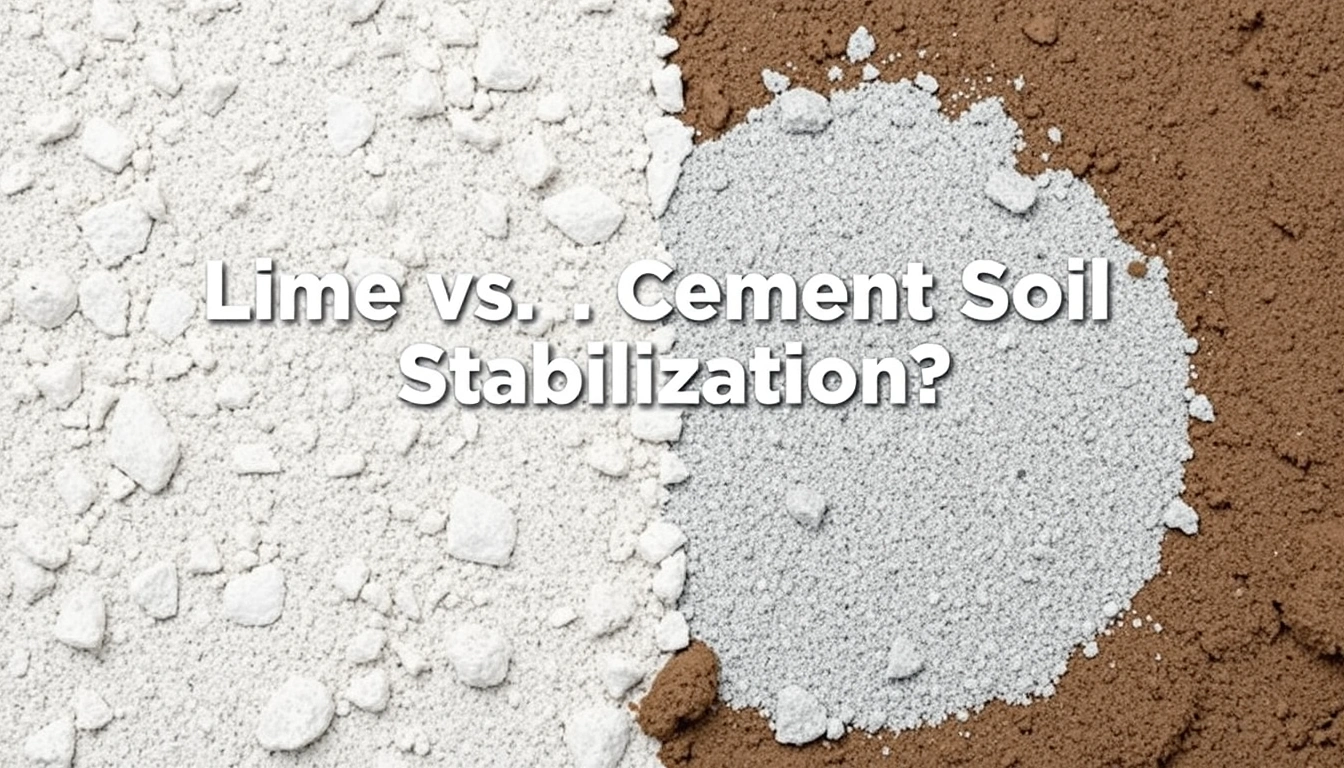
Lime is the better stabilizer when the problem is plastic, moisture-sensitive clay; cement is better when the goal is immediate stiffness and higher early strength. That is the short version. But the right call still depends on the soil report, the structure, and how fast the foundation has to go up.
For Texas foundation work, that split matters because many sites from Bexar County to Travis County sit on expansive clay. By reducing plasticity, lime changes that clay’s behavior and dries it out during treatment, which helps under slabs and pavements, but the exact design should be verified by a geotechnical professional. Cement binds particles into a harder matrix, which is why it performs well in more granular soils or where a contractor needs a 24-hour to 7-day strength gain rather than a slower soil-conditioning process; TxDOT and ASTM standards are commonly used to guide that work. Mud to rock. Well, not literally — but you get the idea.
I would not call either one “better” in the abstract. Lime is often better for expansive clay under slabs-on-grade in central and south Texas. Cement is often better for weaker sandy subgrades, mixed soils, or repairs where schedule matters more than soil conditioning. If a contractor recommends cement for highly plastic blackland clay without a soil report, I would treat that as a warning sign and ask for a geotechnical review.
Quick comparison table for local foundation work
| Stabilizer | Best fit | Typical local use case | Main drawback | Who should avoid it |
|---|---|---|---|---|
| Lime | Plastic clay, expansive soils | Slab subgrades in Austin, Waco, San Antonio, Temple, New Braunfels | Slower to fully develop benefits; less ideal in clean sand | Sites needing immediate high strength |
| Cement | Sandy or silty soils, fast-track work | Pads, access roads, shallow foundation prep in Houston suburbs, DFW, the Gulf Coast | Can be brittle in highly plastic clay if misapplied | Very wet, highly plastic clay without proper design |
| Lime-cement blend | Mixed soils, variable subgrades | Projects where a geotech wants both conditioning and strength | More design-sensitive; easier to get wrong | DIY jobs or quotes without lab guidance |
What makes lime better or worse than cement in Texas soils?
Lime is better in expansive clay because it changes the clay’s chemistry and workability, while cement is better when the soil needs more direct binding and early strength. That is why the same answer does not apply from Houston’s gumbo clay to a sandy lot near Corpus Christi.
In central Texas, the soil problem is usually not just “soft soil.” It is seasonal movement. Expansive clay can swell after rain and shrink during hot, dry stretches. Lime treatment is commonly used to reduce plasticity and improve the soil’s handling characteristics before slab construction, but a professional should confirm the mix and depth. That makes it especially relevant around Austin, Kyle, Buda, Round Rock, Georgetown, San Marcos, and the surrounding suburbs where clay subgrades are a familiar headache. Same dirt, different headache.
Cement does less to recondition clay and more to create a stiffer engineered layer. That can be useful in Harris County and Fort Bend County where soils vary block by block, or in North Texas where mixed silts and clays are common and time pressure is high. Cement can also be a better fit where the geotechnical report asks for a specific stabilized layer to hit a target strength, and standards such as ASTM D558 or TxDOT specifications often guide the design.
The trade-off is pretty plain:
- Lime needs more patience and usually makes the most sense when the root problem is plasticity.
- Cement gives faster strength, but it is not a cure-all for expansive clay, so a soil report should drive the decision.
- Lime-cement blends can work well when the soil profile changes within the same lot, which is common on infill parcels in Dallas, Fort Worth, and older neighborhoods in San Antonio.
If your lot has fill, old demolition debris, or layered soils, the right stabilizer may be neither plain lime nor plain cement until a geotechnical engineer has reviewed the borings and moisture conditions.
How much does soil stabilization cost in Austin, San Antonio, and nearby areas?
Soil stabilization for foundations in Central and South Texas usually varies by square footage, treatment depth, haul-off needs, and whether the contractor is treating just the building pad or the whole work area, so a geotechnical or foundation professional should confirm the scope before you sign. A 2026 budget can shift quickly with soil conditions, but the local cost driver is almost always the same: more moisture correction, more depth, and more verification mean more labor and material. No mystery there.
Here is a practical local cost frame for Austin, San Antonio, and nearby service areas such as Cedar Park, Pflugerville, New Braunfels, Schertz, Boerne, and Seguin:
| Service variation | Typical local range | What pushes it higher |
|---|---|---|
| Lime treatment for a residential slab subgrade | Low to mid four figures for small pads; more for larger lots | Deep treatment, high moisture, poor access, rework |
| Cement stabilization for a residential slab subgrade | Often higher than lime for comparable area | Fast-track schedule, higher binder content, multiple lifts |
| Lime-cement blend treatment | Usually the most design-dependent | Engineer-required mix, field testing, variable soils |
| Re-treatment after failed prep | Can add a substantial second mobilization | Saturated soil, rain delay, poor proofrolling |
| Testing and verification | Separate line item in many bids | Field density checks, lab mix design, geotech oversight |
I am avoiding hard dollar numbers here because pricing changes with soil report requirements, access, and local labor. A quote that looks cheap can be missing critical items such as moisture conditioning, scarifying, mixing, compaction, or proofrolling. In places like Travis County and Bexar County, that omission can matter more than the difference between lime and cement itself.
If a contractor serves the broader Austin and San Antonio corridor, including Dripping Springs, Lakeway, New Braunfels, Converse, and Universal City, I would expect the quote to separate:
1. material,
2. application,
3. mixing,
4. compaction,
5. testing.
If those are bundled into one vague line, ask for a breakdown before you sign. Clean invoice, muddy scope? Walk away.
When lime is the better foundation choice
Lime is the better choice when the site has high-plasticity clay, a slab-on-grade design, and enough lead time for proper treatment and verification. That is the profile I would expect on many homes west and south of the I-35 corridor, especially where blackland clay or other expansive subgrades dominate.
Lime works by reducing plasticity and making the soil less sensitive to moisture swings. That matters under foundations because the foundation does not fail only when the soil is weak; it also fails when the soil keeps changing volume. A treated clay layer can give a more predictable working platform for the slab, which is why geotechnical reports in Texas often specify lime on clay sites. Sticky clay. Lime calms it down.
Lime is usually a poor choice when:
– the soil is mostly clean sand,
– the project needs immediate high early strength,
– the site is too wet to condition properly,
– the contractor cannot control mixing depth or moisture.
That last point is not minor. A lime application that is spread badly, mixed shallow, or left too wet can underperform the whole point of the treatment. If a builder in Austin, Temple, Killeen, or San Antonio is pushing lime as a cheap fix without addressing drainage, compaction, or proper curing, I would be cautious and ask for the geotechnical basis in writing.
When cement is the better foundation choice
Cement is the better choice when the subgrade needs strength fast, the soil is less plastic, or the project calls for a more rigid engineered layer. That is often the case for commercial pads, tight schedules, and some residential infill lots in Dallas–Fort Worth, Houston, and fast-growing suburbs like Frisco, McKinney, Pearland, Katy, and Sugar Land.
Cement-stabilized soil gains strength through hydration, which is why it tends to be favored when early loading matters. It can also be useful where the soil is too variable for lime alone to be the cleanest answer. If the report calls for a cement-treated base or a cement-modified layer, that usually means the engineer is chasing stiffness and bearing capacity, not just moisture conditioning.
Cement is not automatically better for foundations, though. It can be the wrong choice on highly plastic clay because a stiff layer over active clay can move differently than the untreated surrounding soil if the design is incomplete. That is one reason I would not choose cement as a blanket answer for the entire Austin or San Antonio market.
Cement is also less forgiving on a rushed site. If the mix is wrong, the moisture content is off, or compaction is poor, you can end up with a hard-looking layer that still does not perform under a slab. A pretty surface is not the same as a good subgrade, and a contractor should be able to explain the mix design before work starts.
How to vet a foundation contractor in your area
The right contractor can explain the soil report, the stabilizer choice, and the compaction plan in plain terms within 15 minutes. The wrong one talks only about material and never mentions moisture, depth, testing, or the local clay.
In Austin, San Antonio, and the surrounding counties, I would ask these questions before booking:
– What does the geotechnical report specify: lime, cement, or a blend?
– What depth will you treat, and how many lifts?
– Who handles moisture conditioning and proofrolling?
– Will you provide compaction testing or coordinate with the geotech?
– How long before the slab can be loaded?
Those questions matter because Texas foundation work is not just about spreading a stabilizer and moving on. In many areas, the contractor needs to follow the engineer’s design and local permitting rules, especially for slab-on-grade construction, drive pads, or commercial work tied to site development. If the job is part of a permit package in Travis County, Bexar County, or the city limits of Austin or San Antonio, the stabilizer choice may need to match the approved structural and geotechnical documents, so check the plan set before work begins.
A contractor who serves a broad area from Cedar Park to New Braunfels, and from Kyle to Schertz, should still be able to explain local soil conditions without guessing. If they dodge the report, that is a red flag.
What can go wrong with lime or cement stabilization?
The most common failure is not the wrong material; it is bad execution on the right material. A lime job can fail if the clay is too wet, the mixing depth is shallow, or the curing plan is ignored. A cement job can fail if the soil is too plastic, the water content is wrong, or the layer is loaded before it has developed enough strength.
Other problems show up often in central and south Texas:
– Rain delay after treatment
– Poor access on tight urban lots
– Fill soils that were never characterized
– Under-drainage or poor site drainage
– No field density checks
– Treated soil left exposed too long before foundation work
That is why I would not hire on a low bid alone. A cheap quote can hide a second mobilization after a rain event, extra trucking, or a failure to hit the engineered moisture content. In places like Houston, where storms can turn a site soft in a day, schedule risk matters just as much as material choice.
If you need urgent work or same-day pricing, ask whether the contractor can at least inspect the site, review the soil report, and provide a written scope within 24 to 48 hours. A free estimate is useful only if it includes the treatment method, not just a number. Otherwise? Paperwork, not planning.
Lime vs cement for foundations in local weather and season
Lime usually has an easier path in dry, hot months, while cement can be more attractive when the schedule is tight and the site can be protected from moisture swings. In Austin, San Antonio, Waco, and nearby towns, summer heat can help drying but also makes moisture control more sensitive. In wetter periods, especially after heavy spring rain or Gulf Coast storms, both stabilizers become harder to place correctly.
Season matters because these are moisture-sensitive processes. If the subgrade is saturated, neither lime nor cement will perform well without proper drying, scarifying, and reworking. In North Texas, late spring and early fall are often friendlier windows for this kind of prep. Along the Gulf Coast, the bigger issue is often not temperature but rainfall and drainage.
If you are trying to decide whether to book now or wait, I would use this rule of thumb:
– Book sooner if the lot is already scheduled for excavation and the report is complete.
– Wait if the soil is visibly wet, the drainage is unresolved, or the site needs regrading first.
– Do not let the slab crew outrun the soil prep crew.
That timing advice is not glamorous, but it saves more foundations than any sales pitch about a miracle material. Boring, yes. Effective, too.
FAQ: lime vs cement soil stabilization for foundations
Is lime or cement better for expansive clay?
Lime is usually better for expansive clay because it reduces plasticity and improves workability, which is why it is common in Austin, San Antonio, and other Texas clay markets.
Can I use cement instead of lime for a house foundation?
Sometimes, but not automatically. Cement can work on some subgrades, yet it is not the default fix for highly plastic clay, and I would only use it when the geotechnical report or engineer supports it.
How long does soil stabilization take before foundation work starts?
That depends on the method and weather, but many jobs need at least 1 to 7 days for treatment, mixing, compaction, and verification before the slab crew moves in.
Can I get same-day soil stabilization service?
Same-day scheduling is possible for an inspection or mobilization on some jobs, but actual treatment usually depends on access, soil moisture, and whether the engineer’s scope is already in hand.
Should I ask for a free estimate?
Yes, but only if the estimate names the stabilizer, treatment depth, compaction steps, and testing. A free number without that detail is not very useful.
So which one should you choose?
Lime is my first choice for expansive clay foundations in much of Central and South Texas. Cement is my first choice for